Every year, we host 6th form geography students from local Plymouth schools, to allow students to gain an insight into life as a Coastal Process Scientist. This year Emily and Romana joined us for four days. Here’s how they found it.
Emily:
“A four day placement at South West Coastal Monitoring provided an amazing insight into the world of coastal surveying, from out in the field to computer programs. We were also introduced to some of the university’s facilities including the Marine Building, the Marine Station and their vessels with their new surveying equipment. We were given a tour of the wave tank simulator which we were able to see in action, as well as learn about the fascinating projects that were carried out there.
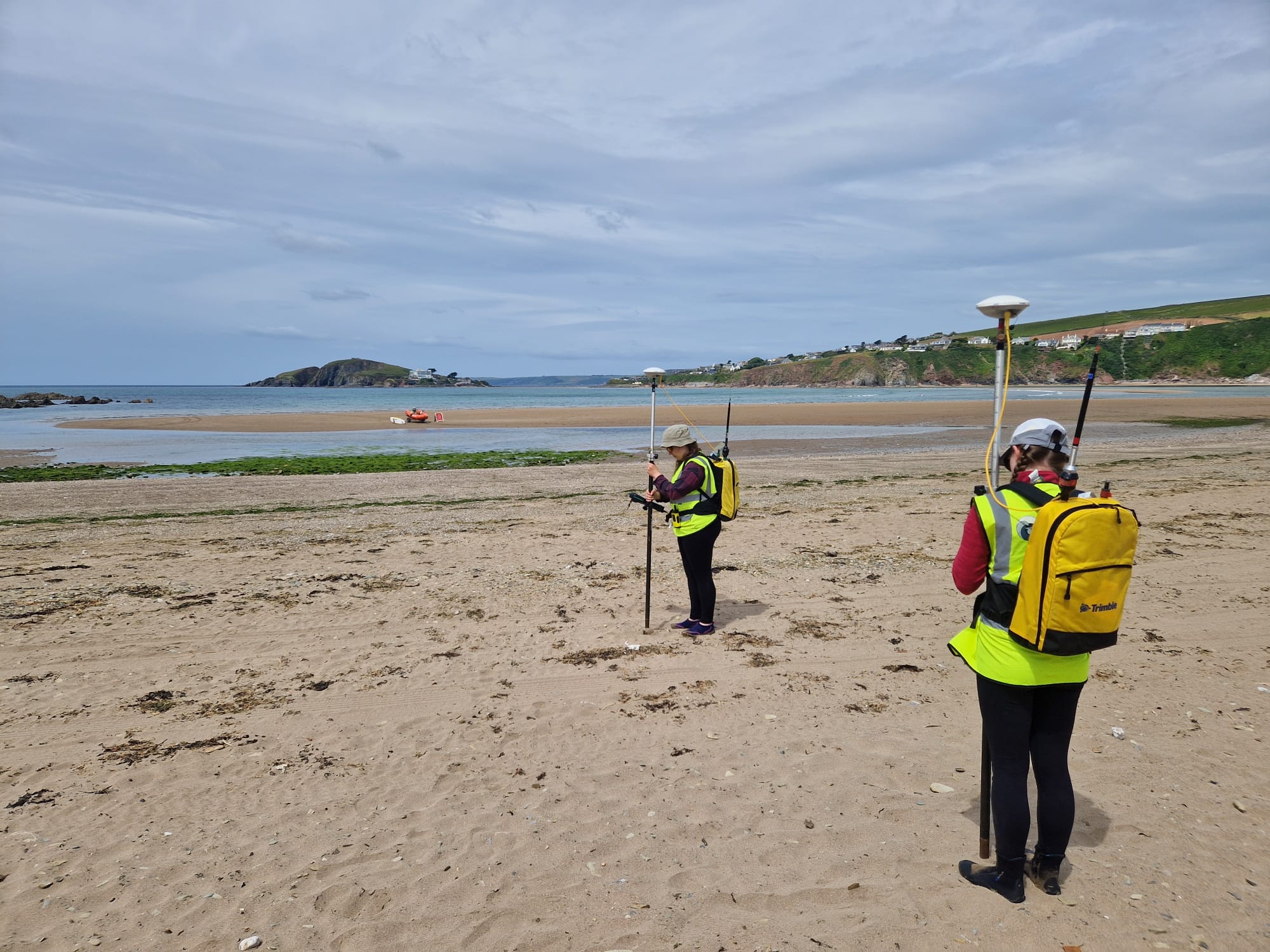
“Over two days, we conducted topographic surveys on the beaches of Bantham and Bigbury. We learned how to set up and use Trimble technology and equipment, which recorded and stored our survey measurements. Walking along a survey line, we took measurements of the height and material composition of the beach and dunes.
“In the office following our field surveys, we received coaching on using software like SANDS, MATLAB to process and quality-check the data. Using the graph data we plotted in SANDS, we compared our findings to previous data, allowing us to assess how the beach has changed over time. We were also introduced to other survey methods and technologies such as LiDAR, which opened new possibilities for data collection.
“This placement taught me valuable new skills that will support my future in geography and environmental science. My time with the SWCM team was not only highly educational but also enjoyable. The friendly and supportive atmosphere they created encouraged me to ask questions and engage in activities, greatly enhancing my experience.”
Romana:
“I was interested in this placement because I do Geography at A-level, and hoped to see how the things I’d learned in school could apply to a real work place. We started the week by looking at the different types of data collected by SWCM, the equipment needed to do a topography survey, and how to set up a base.
“We visited the wave tank and learnt about the process of producing artificial waves to test devices like floating wind turbines. This was one of my favourite parts of the placement, because I was expecting a small tank that was only a few metres big, instead it was an entire room; it was very exciting when the machine was switched on, and we were told about the different types of waves, and how the hydraulic systems could produce them.
“For the next two days, we visited the beaches of Bantham and Bigbury, and conducted a survey of the topography using Trimble technology. We helped set up the equipment and take readings that we could analyse once we got back to the university. The best part of the fieldwork was getting to learn all the different codes for materials and at what point a “d” (dune) becomes a “dv” (vegetated dune). Once we had put the data we collected into a graph, we were able to compare it to previous surveys. It was really interesting to see how the beach has changed over time, and thinking about what might have caused this variation. But before this, it was important to quality control our data to ensure that it was labelled correctly, and to see why there were gaps in our data. For example, at Bantham, we came across a life boat, meaning we couldn’t record the data at the usual 5 metre intervals. But, because we’d labelled this as a foreign body during the survey, we expected there to be a hole in the data when we were quality controlling.
“I’ve had a great few days at SWCM learning so much about what a career with geography could look like, how to work with other people effectively, and making new friends. So, thank you SWCM for giving me this opportunity. “
Let's Keep In Touch
We’ll keep you up-to-date with all the latest news on this website, but we’d also love to be able to send the occasional update.
We promise we'll only use your details to tell you about what we’ve been doing.