The SWCM team recently welcomed three local school students for a four day work experience placement. We gave them a hands on introduction to the varied work involved in monitoring and managing the South West’s coastline.
The students brought plenty of energy and enthusiasm to the week, asking thoughtful questions and showing a real interest in coastal processes, surveying and data analysis.
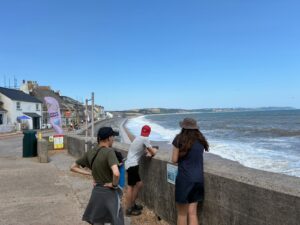 Day 1: Coastal change in Start Bay
We began with a coastal walk from Hallsands to Torcross to explore the challenges of coastal change and adaptation in Start Bay. A brisk easterly wind and energetic swell created dramatic conditions, providing a perfect demonstration of how quickly the sea can change a coastline – even in summer.
Along the way, we considered how sea-level rise is affecting local communities and looked at the recent damage to the road and seafront properties at Torcross. A Conversation with a local resident highlighted that managing coastal risk is not only a technical challenge; it also requires clear communication and an understanding of people’s experiences. One student is studying sociology alongside geography, which we agreed is a particularly valuable combination for understanding both the physical processes and human dimensions of coastal adaptation.
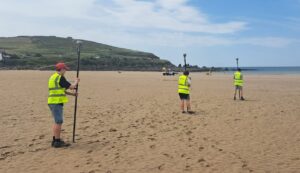 Day 2: Surveying at Bigbury-on-Sea
We headed to Bigbury-on-Sea, where the students helped carry out a topographic beach profile survey. They learnt how to level the tripod, set up the GNSS base station and collect measurements of beach elevation. These repeat surveys contribute to the long-term record used to understand how beaches change over time.
Once the equipment had been packed away, there was just enough time for a well-earned paddle in the sea to cool down!
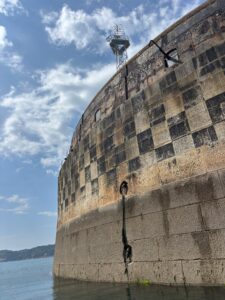 Day 3: Coastal assets and data
Day three began on Plymouth’s waterfront, where our Assets Team, Cecily and Phoebe, introduced the students to coastal defences and showed them how assets are inspected, assessed and recorded. An ice-cream stop may also have found its way into the itinerary!
Back in the office, the students helped process the survey data collected at Bigbury and took part in a GIS workshop, seeing how field measurements are transformed into useful information for coastal monitoring and management.
Day 4: Python and Plymouth Sound
The final day began with an introduction to Python programming from our GIS Lead, Tom. In the afternoon, we visited the University of Plymouth’s Marine Station, where Aaron introduced the students to marine autonomy and the technology used to study the marine environment.
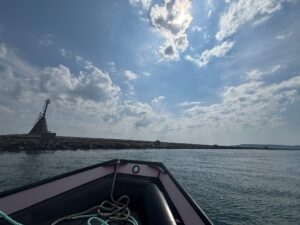
The week finished with a boat trip around Jennycliff and out towards Plymouth Breakwater and the Hoe. Seeing the coast from the water offered a different perspective on the local coastline and brought together many of the topics explored during the placement.
It was a busy and enjoyable four days, combining practical fieldwork, technology, data analysis and conversations about working with coastal communities. We hope the experience gave all three students a real taste of coastal science and a better understanding of the wide range of careers involved in monitoring and managing our marine and coastal environments.
A huge thank you to the students for bringing such curiosity and enthusiasm to every activity – we hope to see some of them working on the coast again in the future!
Let's Keep In Touch
We’ll keep you up-to-date with all the latest news on this website, but we’d also love to be able to send the occasional update.
We promise we'll only use your details to tell you about what we’ve been doing.